Best Lawn Mower for Hills and Sloped Yards
Mowing a slope? How drive type, traction, mowing direction and maker slope limits shape the choice, plus three self-propelled cordless mowers worth a look.
At a glance
For a hilly lawn, the Toro 60V 21-inch Recycler has rear-wheel-drive self-propel for traction. The EGO LM2135SP adds swappable blades and variable-speed Touch Drive, and the EGO LM2125SP is the mid-range option. Mow across slopes with a walk-behind, and follow the maker's slope limits.
A hill changes everything about mowing. The machine works harder, the battery drains faster, your footing is worse, and a mistake costs more. A sloped yard rewards a mower that keeps traction and punishes one that does not. It also rewards good habits: the direction you mow, the conditions you choose and the limits you respect.
The details below come from the makers’ published specifications and from safety and mowing guidance by the Consumer Product Safety Commission (CPSC) and two university extension services. We note where a maker leaves a detail out. Nothing here replaces the slope warnings in your own operator’s manual.
Know Your Slope Before You Pick a Mower
University of Georgia Extension gives a simple way to measure. Mark a 10-foot run, and measure how far the ground drops over it. Slope in percent equals rise divided by run, times 100. A drop of 2.7 feet over 10 feet is a 27 percent slope, which Georgia Extension gives as the limit for riding mowers: it says they will slide and roll over on slopes greater than 27 percent. A 3-foot drop over 10 feet is 30 percent, which it calls too steep to mow safely.
Maker figures are often given in degrees. EGO says its Z6 zero-turn handles 15-degree slopes under ideal conditions. Fifteen degrees works out to roughly 27 percent, so the two figures agree. The Z6 is a riding mower and is not in this guide’s picks, but the number is a useful reference for how limited riders are on a hill.
Walk-Behind and Rider Mowing Directions Are Opposite
This is the most useful rule in this guide, and it is counterintuitive.
- Walk-behind mowers go across the slope. Iowa State University Extension says to mow across a slope rather than up and down, which makes you less likely to slip under the mower and means it cannot roll back on you. University of Georgia Extension says to start at the bottom of the slope and mow back and forth across it, working toward the top.
- Riding mowers go up and down. Iowa State says riding mowers can tip easily, so mow up and down. Georgia Extension says to mow up and down slopes under its 27 percent limit and to turn only on level ground at the top and bottom.
The takeaway for this guide: the mowers below are walk-behinds, so you work across the slope. If you own or are considering a rider, CPSC says slopes are a major hazard, because operators have been injured or killed when the mower overturned or when the driver or an extra rider fell off.
Other Iowa State points for walk-behinds on hills: do not mow a slope too steep to keep your balance and control the machine, and push the mower forward rather than pulling it toward your feet. Wear heavy-duty shoes with non-slip soles.
Why Drive Type and Traction Matter
On a flat lawn a self-propel system saves effort. On a hill it affects control. In general, rear-wheel drive holds traction better than front-wheel drive when you push uphill or carry a full bag, because weight shifts toward the rear wheels. A mower that drives its rear wheels tends to keep pulling when a front-drive machine would spin or lose bite.
Three practical things also matter:
- Wheel size. Toro lists 8-inch front and 10-inch rear wheels on its Recycler, which helps on uneven turf.
- Variable speed. A speed dial lets you slow down on the steep parts and speed up on the flats, which both EGO mowers offer.
- Weight. A lighter mower is easier to control, but a heavier one holds the ground. According to Toro, its Recycler weighs 65 lbs. EGO does not list a weight for either of its mowers.
Wet Grass, Battery Drain and Other Hill Habits
- Skip wet grass. Iowa State says you are more likely to slip on wet grass and that it can clog the mower. Ohio State University Extension says wet turf cuts unevenly and prevents good mulching.
- Mow before it gets tall. Ohio State’s one-third rule says never to remove more than a third of the leaf blade length at once. A mower already working against gravity should not also be fighting tall grass.
- Expect shorter runtime. EGO lists steep terrain among the things that shorten runtime on the LM2135SP, along with tall, thick or damp grass and low cutting heights. Toro says its run time and yard-size numbers are best on flat, dry, evenly cut lawns.
- Clear debris first and keep the guards on. CPSC advises raking before you mow, wearing sturdy shoes and safety glasses, not removing safety guards and not standing in line with the discharge chute.
- Cover the steepest part separately. Where a slope is too steep to walk with control, Iowa State suggests a weed whip instead.
Three Self-Propelled Mowers for Sloped Yards
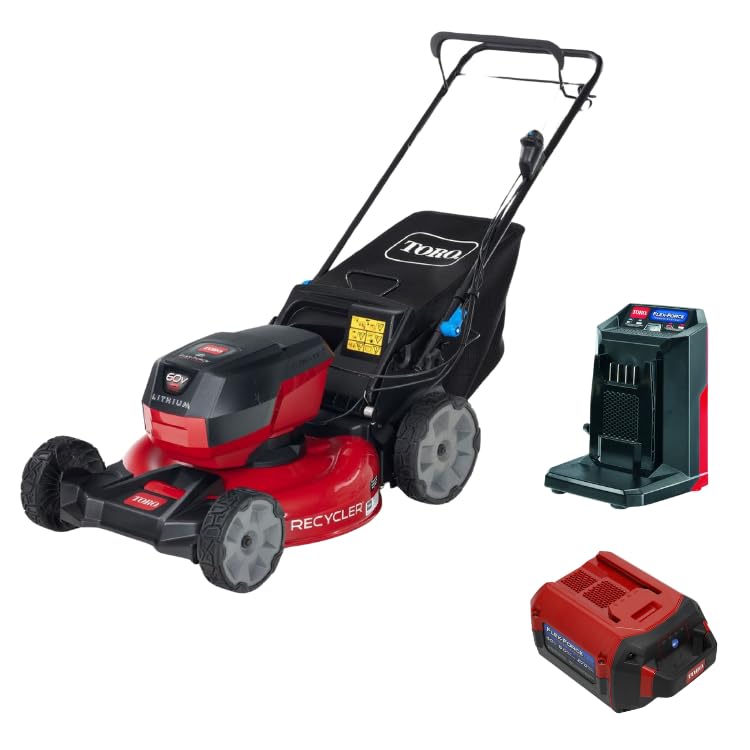
Rear-Wheel Drive for Traction: Toro 60V 21” Recycler
A mid-range cordless mower with rear-wheel-drive self-propel and variable speed. Fits yards up to 1/3 acre with moderate slopes.
According to Toro, this mower has a 21-inch 15-gauge steel Recycler deck, rear-wheel-drive self-propel with variable speed, a brushless motor, a 5.0Ah 60V battery and charger included, up to 43 minutes of run time and a 230-minute charge time, and a weight of 65 lbs. Toro rates it for yards up to 1/3 acre. The rear-wheel drive is the main reason it is first here. The limits matter on a hill: one battery, one port and a long recharge mean a hilly third of an acre will likely need a second pack. The side discharge chute is free on registration. Read the Toro 60V Recycler profile for more.
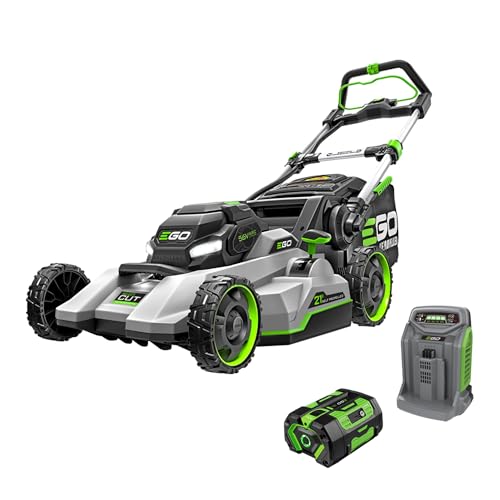
The Premium Pick With Variable Speed: EGO LM2135SP Select Cut
A premium cordless mower with Touch Drive speed control and swappable lower blades. Fits sloped lawns where you want to slow down on the steep parts.
EGO says this mower has a 21-inch deck with eight cutting heights from 1 to 4 inches, a brushless motor with up to 7.0 ft-lbs of cutting torque, a 56V 7.5Ah battery and Rapid Charger, Touch Drive self-propel with variable speed from 0.9 to 3.1 MPH, up to 60 minutes of runtime, LED headlights and a 5-year tool warranty. The Select Cut system includes an extended-runtime lower blade, which helps when a hill drains the battery. EGO does not say which wheels are driven or what slope limit applies, so read the manual before you commit. See the EGO LM2135SP profile.
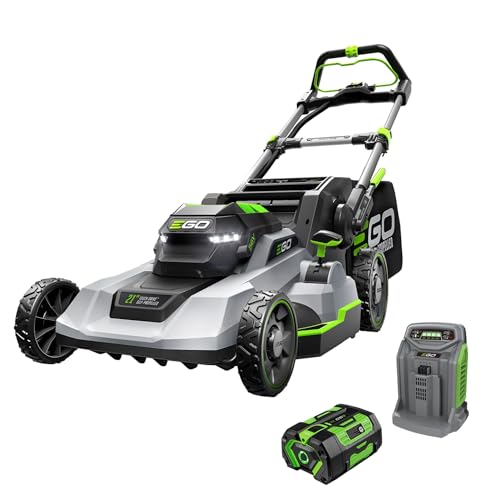
The Mid-Range EGO: LM2125SP Touch Drive
A mid-range self-propelled cordless mower with a 7-position height range and a folding design. Fits gently sloped suburban lawns.
The LM2125SP is the lower-cost route to EGO’s Touch Drive system. According to EGO, this family has a 21-inch deck with seven height positions from 1.25 to 4 inches, up to 6.0 ft-lbs of cutting torque, up to 60 minutes of runtime on the 7.5Ah battery, about 60 minutes of charge time, a 3-in-1 design with a two-bushel bag, and a 5-year tool warranty. EGO does not list a weight or numeric speeds. Self-propel helps the mower move, but it does not make steep ground safe. The EGO LM2125SP profile goes through the details.
Quick Comparison
| Mower | Drive | Deck | Notes |
|---|---|---|---|
| Toro 60V 21” Recycler | Rear-wheel, variable speed | 21 in | 65 lbs, rated for up to 1/3 acre |
| EGO LM2135SP | Touch Drive, 0.9 to 3.1 MPH | 21 in | Extended-runtime blade, premium |
| EGO LM2125SP | Touch Drive, dial speed | 21 in | Mid-range, folds flat |
How to Choose
Measure the slope first. If it is gentle, any of these mowers is a reasonable fit, and the choice comes down to budget, warranty and blade flexibility. If it is moderate, favor the Toro for its rear-wheel drive and plan for a spare battery. If it is steep enough that you cannot keep your footing, the answer is a weed whip or professional help, not a bigger mower.
For a mixed property with flat open sections and steep banks, a rider for the flats and a walk-behind for the banks is the sensible combination. Our big-yard guide covers when to add a rider. See our best lawn mowers of 2026 comparison for the full ranking.
Sources
Frequently asked questions
Should I mow up and down a slope or across it?
It depends on the mower. Iowa State University Extension says to mow across a slope with a walk-behind rather than up and down, so you are less likely to slip under the mower and it cannot roll back on you. For riding mowers it says the opposite, to mow up and down, because they can tip easily. University of Georgia Extension gives the same split. Always follow your operator's manual.
Is rear-wheel drive better on a hill?
In general, yes. Rear-wheel drive tends to hold traction better when you push uphill or carry a full bag, because weight shifts toward the rear wheels. The Toro 60V 21-inch Recycler is listed by Toro with rear-wheel-drive self-propel. EGO does not say which wheels the Touch Drive system powers, so check the manual.
How steep is too steep for a riding mower?
University of Georgia Extension says riding mowers slide and roll over on slopes greater than 27 percent, which means a drop of 2.7 feet or more over a 10-foot run. EGO says its Z6 zero-turn handles 15-degree slopes under ideal conditions, and 15 degrees works out to about 27 percent. The CPSC calls slopes a major hazard for riding mowers.
Can I mow a slope when the grass is wet?
Avoid it. Iowa State University Extension says you are more likely to slip on wet grass and that it can clog the mower. Ohio State University Extension adds that wet turf cuts unevenly and prevents good mulching.
Does self-propel make a steep slope safe?
No. Self-propel moves the mower, but it does not change what is safe for you to walk on. If you cannot keep your footing and control the machine, the slope is too steep for a walk-behind. Iowa State suggests a weed whip on slopes that steep.
Do I need a bigger battery on a hilly lawn?
Plan for more drain. EGO lists steep terrain among the things that shorten runtime on its LM2135SP, alongside tall, thick or damp grass and low cutting heights. Treat each maker's runtime number as a ceiling.